♓ Tropical sign
Pisces
A mutable water sign shown as two fish, traditionally Jupiter-ruled, with Neptune added in many modern lists, closing the tropical year.
Introduction
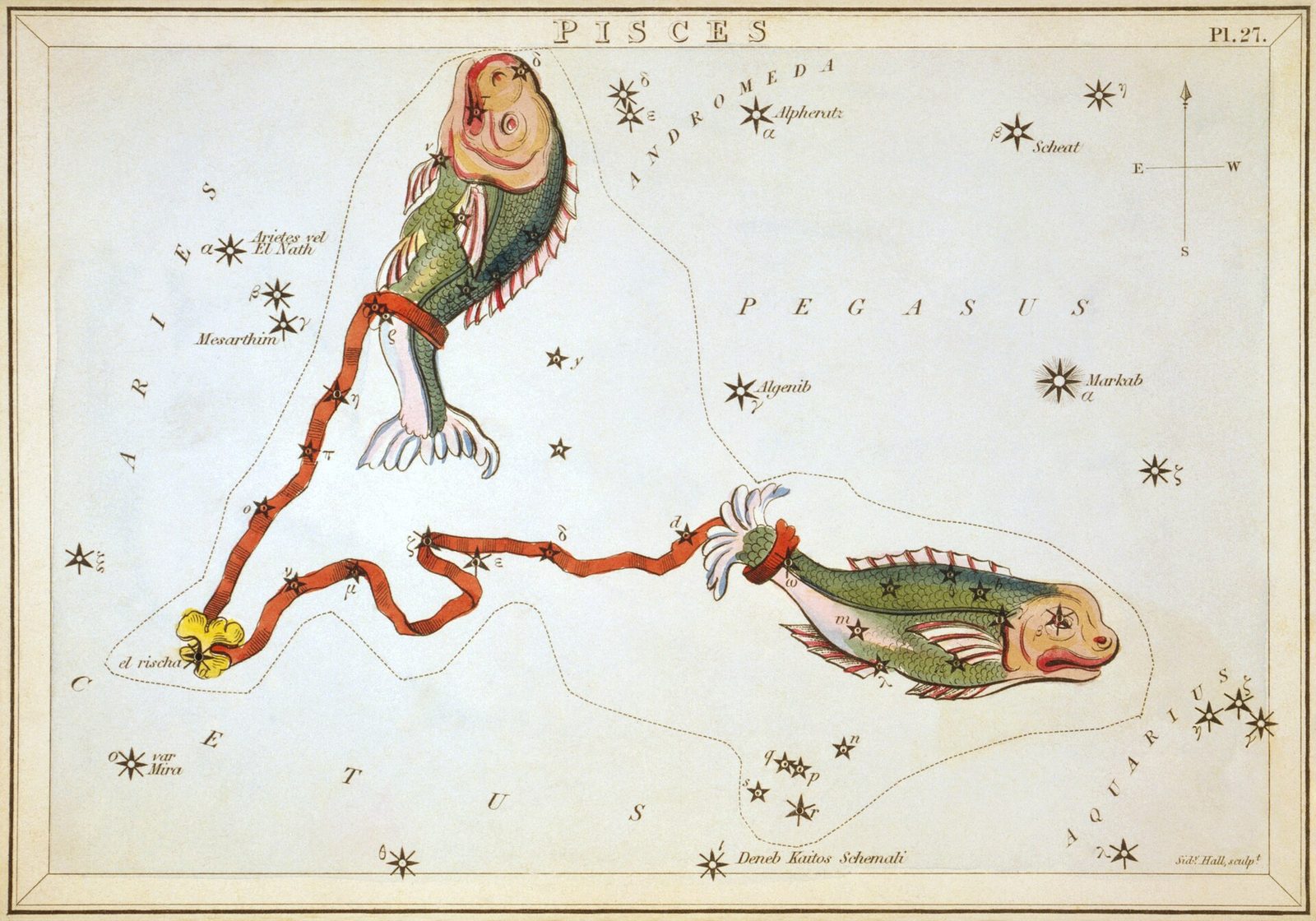
Pisces is the last sign of the tropical zodiac, the tide before Aries begins the year-count again. Two fish, often tied by a cord, swim in different directions—an image later writers used for divided attention, compassion, and the difficulty of choosing a single story.
Traditional astrology gives Pisces to Jupiter, a wet Jupiter of sanctuary and faith. Modern astrology often adds Neptune and talks about film, fog, and the oceanic. This page labels those as different centuries of interpretation. Boundlessness is a symbol, not an instruction to abandon discernment.
Symbol
The traditional emblem is two fish. Glyph: .
Mutable water is used for mixing: rivers meeting, borders softening, music as a solvent. The cord between fish (in many maps) is as important as the fish: connection that can look like help or like tangle.
Seasonally, late winter in the Northern Hemisphere is a time of scarce light and stored food, which colored some older medical and agrarian notes about the sign.
Historical background
Fish on this part of the sky appear in classical mapping. Jupiter as domicile ruler is traditional; Neptune, discovered in 1846, enters modern rulership debates later. Christian fish symbolism is a separate history that sometimes gets casually merged with Pisces in popular writing; they should not be treated as the same origin story without care.
Hall’s Pisces card shows the paired fish that still dominate the emoji-era glyph.
Commonly associated traits
Popular lists: empathetic, imaginative, unworldly. Traditional Jupiter-in-water language includes refuge and excess moisture metaphors. Neptunian modern language adds dreams and dissolution. None of it is a psychiatric description.
Strengths
Reflective uses: hospitality to feeling, artistic absorption, willingness to forgive a plot that is not linear.
Challenges
Stock cautions: evasion, poor boundaries, preferring mood to appointment times. Motifs about mutability and water.
Love and relationships
Pisces romance copy is often about merging. Popular pairings include Cancer, Scorpio, Taurus, and Capricorn. Traditional synastry still examines Venus, the Moon, and Jupiter. Cultural interpretation, not a guarantee.
Friendship
Friendship tropes: the late-night listener, the friend who forgets the plan but remembers the feeling.
Work and interests
Vocational motifs: arts, care, hospitality, maritime work in old lists, charity. Historical Jupiter also concerns temples and hospitality law.
Compatibility overview
Water–earth is often called a harbor. Water–air is often called weather. Interpretations vary. No pairing is certain.
Astrology compatibility is a cultural interpretation rather than a scientifically validated method of predicting relationship outcomes. See also Compatibility.
Related zodiac signs
Aquarius
A fixed air sign shown as a figure pouring water, traditionally Saturn-ruled, with Uranus added in many modern planetary schemes.
Learn moreAries
A cardinal fire sign associated with beginnings, initiative, and the ram as a seasonal emblem of spring in the tropical zodiac.
Learn moreCancer
A cardinal water sign linked to the Moon, the Northern summer solstice in tropical astrology, and crab or crayfish imagery on historical star maps.
Learn moreScorpio
A fixed water sign figured as a scorpion, traditionally ruled by Mars, with Pluto added in many twentieth-century modern systems.
Learn moreRelated guides
Guide
The Four Elements in Astrology
The four elements sort the twelve signs into fire, earth, air, and water. This guide explains the scheme, triplicity ideas, and how to use the language without treating it as a lab result.
Read essayGuide
Sun Sign vs Moon Sign
The Sun sign is the familiar magazine label. The Moon sign tracks a faster cycle and often needs a birth time. This guide explains how traditional and modern writers treat the pair.
Read essayGuide
What Is a Zodiac Sign?
A zodiac sign is a named slice of the ecliptic used in natal diagrams. This guide separates signs from constellations, dates from myths, and magazine adjectives from older teaching.
Read essayGuide
How Zodiac Compatibility Is Traditionally Interpreted
Zodiac compatibility is a set of reading habits, from magazine pairings to full-chart synastry. This guide maps those habits so you can enjoy the language without treating it as a verdict on love.
Read essayFrequently asked questions
Jupiter or Neptune?
Traditional astrology uses Jupiter. Many modern schools use Neptune as ruler or co-ruler of Pisces.
Why two fish?
That is the inherited constellation figure, often joined by a cord in European maps.
Is Pisces the end of the zodiac?
In the usual tropical teaching order, yes: Pisces is twelfth, Aries first. Other cultures order the year differently.
Does Pisces mean someone is psychic?
No. Psychic claims are outside what this site treats as cultural astrology education.